


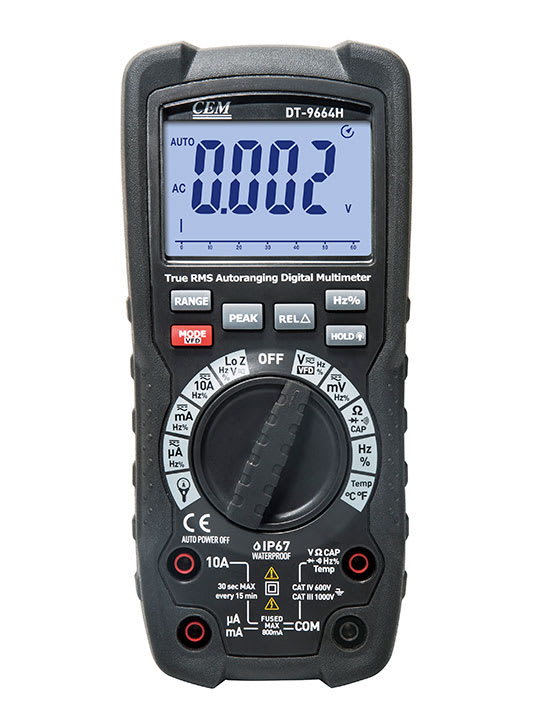


CEM DT-9664H, as fundamental troubleshooting tool, helps technicians check electrical readings and find problems. For instance, it can measure line voltages (like 120 or 240 volts AC), the current drawn by blowers and compressors, the output of a control transformer (such as 24 volts AC), and whether a coil has continuity. It’s also used to test sensor circuits—like thermostats and pressure switches—and safety components, including limit switches and flame sensors.
Essential functions for these tools, incl.
- AC Voltage (VAC): Verify supply and control voltages (e.g. 120/240 VAC power, 24 VAC thermostat circuits).
- AC Current (AAC): Measure load currents of fans, motors, compressors using a clamp meter. Typical range is 0–100 A or more.
- Resistance/Continuity: Check motor windings, coils, fuses, and switch continuity (ohms/continuity). Low-resistance ranges (down to 0.1 ohm help test coils, while higher ranges (megaOhm) test insulation.
- Capacitance: Test run and start capacitors (uF). Typical HVAC capacitors are 5–60 uF. Capacitance measurement is crucial for motor starting circuit checks.
- Microamp DC (uA): Flame sensor testing in gas furnaces. Flame rectification currents are typically 2–10 uA; specialized HVAC meters measure DC uA for this.
- Temperature: Many HVAC meters include a type-K thermocouple input for measuring refrigerant line, ambient, or component temperatures.
Clamp meter for HVAC:
some HVAC specifica feaures, like High Current (Inrush) Measurement, need to be found in clamp meter DT-9282
Safety:
IEC61010-1 CAT IV 600V / CAT III 1000V
UL, CSA, and TÜV listed for maximum safety and global compliance
Applications:
-- Measuring Compressor Current
-- Testing Motor’s Capacitors
-- Thermostat Circuits and Controls
-- Temperature Measurement
-- Flame Sensing
Practical HVAC electrical testing and maintenance procedures
Safety checks
Always start with the meter on a safe range (or auto-range), and verify it on a known source before measuring (e.g. confirm 120 VAC on a live outlet). Follow lockout/tagout: de-energize circuits whenever possible. When measuring voltage or current, ensure probes/clamp are properly rated. Use the meter’s continuity beep to test fuse and switch continuity quickly
Measuring Compressor Current
use a clamp meter around one power wire. For starting current, use the meter’s min/max or peak setting. Compare your reading to the compressor’s rated amps
Testing Motor’s Capacitors
An HVAC meter must measure capacitance in microfarads (uF) to test if a capacitor is weak, open, or shorted. This is the number one cause of motor failures in the field.
Thermostat Circuits and Controls
HVAC thermostats usually use 24 volts AC. To test, measure between the R terminal (power) and W (heat) or Y (cool) at the thermostat or control board.
Temperature Measurement (Type-K Thermocouple)
This allows the HVAC technician to measure superheat and subcooling—the two critical metrics for determining if a refrigeration system is properly charged with refrigerant.
DC Microamps (uA) for Flame Sensing
To prove a gas flame is lit, the furnace uses a flame sensor. The sensor generates a tiny electrical current .
An HVAC meter must have a uA (microamp) setting to diagnose faulty flame sensors, which are a common cause of intermittent heating failures.

Features
tool application |
HVAC application: Measuring Compressor Curren / Thermostat Circuits and Controls / Safety check, etc. |
safety ratings |
IEC/EN 61010: CAT IV 600 V / CAT III 1000 V |
|
|
|
True RMS |
Industrial systems often use non-linear loads (VFDs, inverters, motors). True RMS ensures accurate readings even with distorted waveforms |
Accuracy |
DCV basic accuracy 0.5% |
Measurement functions |
Measurement of AC/DC voltage, current, resistance, capacitance, frequency, temperature, continuity, etc. |
|
|
|
Capacitance Testing - Microfarads (uF) |
An HVAC meter must measure capacitance in microfarads (uF) to test if a capacitor is weak, open, or shorted. This is the number one cause of motor failures in the field. |
Temperature Measurement (Type-K Thermocouple) |
This allows the technician to measure superheat and subcooling—the two critical metrics for determining if a refrigeration system is properly charged with refrigerant. |
DC Microamps (uA) for Flame Sensing |
A standard multimeter cannot read this. An HVAC meter must have a uA (microamp) setting to diagnose faulty flame sensors, which are a common cause of intermittent heating failures. |
Inrush Current |
this function found in HVAC clamp meter DT-9282 |
|
|
|
IP Rating |
IP67 dust and water proof. 2 meter drop protection rated for outdoor use |
Ease of use |
Modern digital multimeters, Easy-to-Use |
certification |
CE, TüV certification |
warranty, certification
All products are CE , GS and TüV certificated.
Based on robust quality and customers’ satisfaction, generally we provide 3 years warranty .


Data Sheet
Data Sheet -- Czechia
Data Sheet -- English
Data Sheet -- French
Data Sheet -- German
Data Sheet -- Italiano
Data Sheet -- Polish
Data Sheet -- Spanish
Data Sheet -- Swedish
Data Sheet -- Turkish
Manuals
User Manual -- Czechia
User Manual -- English
User Manual -- French
User Manual -- German
User Manual -- Italiano
User Manual -- Polish
User Manual -- Spanish
User Manual -- Swedish
User Manual -- Turkish


