


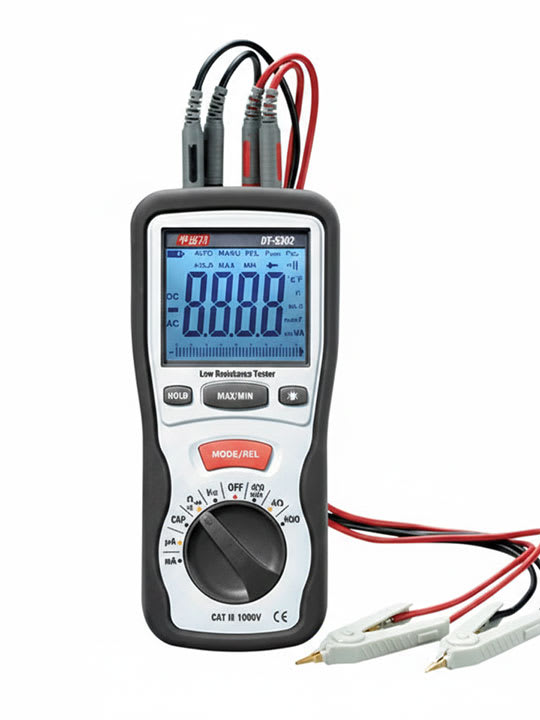


A milliohm meter is a precision instrument designed to measure very low electrical resistance, typically ranging from 1 milliohm (0.001 Ω) to a few ohms—values that are too small for standard multimeters to measure accurately.
A precision instrument used to measure very low electrical resistances, typically in the milliohm (mΩ) or even micro-ohm (µΩ) range
It uses the Kelvin (four-terminal) measurement method to eliminate errors caused by test lead and contact resistance.
When measuring very small resistances, the resistance of the test leads and probe contacts can be comparable to—or even larger than—the resistance being measured.
For example:
- Test lead resistance: 0.1 Ω
- Component resistance: 0.005 Ω (5 mΩ)
A regular 2-wire meter would give an inaccurate reading because it measures both the lead resistance and the component resistance.
The 4-wire Kelvin method solves this problem.

mostly being used in areas
- Battery Internal Resistance: Measuring the health of LiPo, SLA, or Lithium-Ion batteries.
- Motor Winding Resistance: Checking for shorts or opens in copper windings.
- Resistor Matching: Precision sorting of current-sense resistors (shunts).
- PCB Via/Trace Integrity: Checking if a PCB trace has sufficient copper thickness.
- Connector Contact Resistance: Ensuring gold-plated pins or high-power connectors have low resistance.
- Superconductivity/HTS Research: Measuring extremely low resistance values.
Applications:
-- Power & Electromechanical
(Motor & generator windings / Power transformers / Power inductors / Heating elements)
-- Component & PCB Testing
(PCB (Printed Circuit Board) traces / Current sense shunts / Wire and cable resistance / Fuses)
-- Transportation & Infrastructure
(Aircraft outer skin (bonding/lightning protection) / Rail track joints / Ship and mine wiring installations / Automotive high-voltage systems )
-- Connections & Contacts
( Switch and relay contacts / Connectors & bus bars / Compression joints (overhead lines) )
Features
-- ideal for specific omponents / system testing, like PCB traces, Fuses, Power inductors, etc.
-- 4 Kelvin (four-terminal) measurement method: compared with 2-wire meter, this method outputs more accurate measurement
-- low resistance measurements: 400mΩ, 4Ω, 40Ω
-- High accuracy : ± 1.0%
-- Eliminates lead and contact resistance errors
-- test current (to improve accuracy): AC / DC 400µA – 400mA
-- Suitable for precision testing
-- with multimeter functions, like AC / DC Voltage, current, Resistance, Capacitance, MAX / MiN recording etc.
warranty, certification
All products are CE , GS and TüV certificated.
Based on robust quality and customers’ satisfaction, generally we provide 3 years warranty .

Data Sheet
Data Sheet -- Czechia
Data Sheet -- English
Data Sheet -- French
Data Sheet -- German
Data Sheet -- Italiano
Data Sheet -- Polish
Data Sheet -- Spanish
Data Sheet -- Swedish
Data Sheet -- Turkish
Manuals
User Manual -- Czechia
User Manual -- English
User Manual -- French
User Manual -- German
User Manual -- Italiano
User Manual -- Polish
User Manual -- Spanish
User Manual -- Swedish
User Manual -- Turkish
