


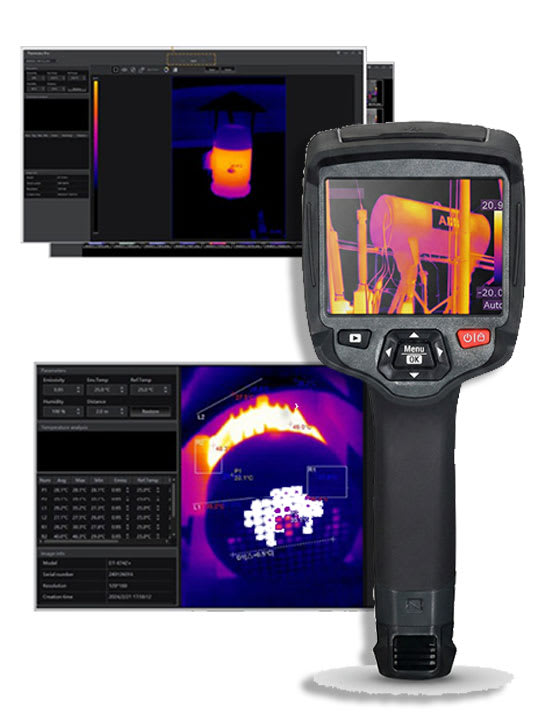


in the production process (Manufacturing)
In factories, thermal imaging works like a fast, touch-free quality inspector. It is especially useful in processes that involve high heat, where normal inspection methods often do not work well.
- Checking Quality in Real Time During Hot Processes:
In processes like press hardening (used to make very strong car parts such as B-pillars), thermal cameras can check the temperature of a part while it is still hot. With the help of AI, the system can quickly decide if the part is good or defective. This allows workers to adjust the process immediately and reduces wasted material. - Finding Hidden Problems Without Damaging Parts:
Thermal cameras can detect problems inside materials that cannot be seen with the human eye. In the automotive industry, they are used to inspect welds, glued joints, and composite materials like carbon fiber. They can find issues such as cracks, separation of layers, or uneven heating — without cutting or damaging the part. - Improving Molding and Casting Processes:
In injection molding and die casting, keeping the temperature even is very important. Thermal imaging checks the surface temperature of molds to find hotspots or cooling problems. These issues can cause defects like warping or shrinkage. The temperature data helps improve mold design and speeds up production. - Optimizing Metal Production:
In metal production, thermal cameras monitor the temperature of molten steel and ensure slabs are heated evenly before rolling. This helps improve product quality, reduce energy use, and make equipment last longer.

Using Thermal Imaging to Prevent Equipment Failure
Thermal imaging is used in condition monitoring to help find problems before something breaks. Instead of asking, “Was this product made correctly?”, it asks, “Is this machine working properly?” The main idea is to watch how a machine’s temperature changes over time. This helps spot problems early.
- Electrical Inspections: Loose wires, overloaded circuits, and broken parts create extra heat. Thermal cameras can safely scan electrical panels from a distance to find hot spots before they cause fires, explosions, or unexpected shutdowns. This also improves worker safety because technicians don’t need to open live electrical panels.
- Mechanical Systems Analysis: Machines like motors, pumps, fans, and conveyors produce normal heat patterns when they work correctly. Thermal imaging can detect unusual heat caused by problems like bad alignment, poor lubrication, slipping belts, or blocked cooling. Finding these problems early allows maintenance to be scheduled, prevents major breakdowns, and helps equipment last longer.
- Monitoring High-Risk Equipment: In industries like steel production, thermal cameras check the condition of furnace linings. A hot spot on the outside can mean the inside lining is damaged or thinning. Detecting this early can prevent serious accidents, such as molten metal leaks.
- Financial Benefits: Unexpected downtime in manufacturing can cost between $125,000 and $260,000 per hour. Using thermal imaging for preventive maintenance can reduce downtime by 30–50% and lower maintenance costs by 30–40% compared to fixing problems only after they happen.

Features
tool application |
equipment condition monitoring |
Type |
Handheld |
|
|
|
High Thermal Sensitivity (NETD) |
high sensitivity allo to detect deven the smallest temperature differences < 50 mK |
High Resolution and Image Clarity |
high resolution identifying subtle issues like minor insulation voids, electrical faults 384x288 pixel |
Image Enhacement |
AUF Patented Fusion Technolog, for precise imaging |
|
|
|
Accurately measure temperature |
-20°C to 650°C (up to 1500 °C , DT-9887H ) |
Intelligent Temperature anaylsis |
Hot / Cold spot tracking. Temperature alarms support |
|
|
|
image / video storage |
support, 4Gbytes eMMC or 8GB SD card |
Data Connection |
support Bluetooth APP wireless data transmission , Data export, Image process and report share |
|
|
|
Display |
640x480 touch screen |
Ruggedness and Usability |
IP 54 |
Ease of use |
Easy to view and analyze images quickly, measurement tests |
certification |
CE, TüV certification |
warranty, certification
All products are CE , GS and TüV certificated.
Based on robust quality and customers’ satisfaction, generally we provide 3 years warranty .

Data Sheet
Data Sheet -- Czechia
Data Sheet -- English
Data Sheet -- French
Data Sheet -- German
Data Sheet -- Italiano
Data Sheet -- Polish
Data Sheet -- Spanish
Data Sheet -- Swedish
Data Sheet -- Turkish
Manuals
User Manual -- Czechia
User Manual -- English
User Manual -- French
User Manual -- German
User Manual -- Italiano
User Manual -- Polish
User Manual -- Spanish
User Manual -- Swedish
User Manual -- Turkish


